Every year, the SEO world declares something dramatic. Some of the SEO trends in 2026 sound like this.
- SEO is dead keyphrase demand is dropping
- AI is taking over the way we do everything
- You need these add-ons to rank for AI searching
- Blogging is dead
- Plugins will fix everything
And every year, business owners panic.
Here’s what I’ve learned after years inside photographers’ websites, looking at real performance data across our industry, reorganizing blog structures that have gotten messy, and watching what actually moves rankings and conversions:
SEO is not a trend game. It’s an infrastructure game.
I don’t ignore trends because I’m unaware of them. Instead, I test them and watch what shifts in real client data, review Search Console patterns, and pay attention to how user behavior changes over time. Then I decide what strengthens the foundation and what’s just noise.
Growth built on hype collapses every time and growth built on structure compounds. I know, I know this is kind of gimmicky sounding but trust me I’ve seen this happen both ways over and over again.
What You’ll Learn in This Post
- Why mass publishing with AI is weakening authority instead of strengthening it
- Why ChatGPT, voice search, and AI results aren’t separate SEO strategies
- The real role of a primary keyphrase in 2026
- How internal linking builds what I call content neighborhoods
- Why accessibility and technical cleanliness are becoming visibility signals
- What sustainable SEO growth actually looks like this year
What I’m Not Following in 2026 when it comes to SEO and Online Visibility
#1 Mass Publishing Blog Posts with AI
Publishing dozens of blog posts because you’re afraid of falling behind is one of the fastest ways to get ignored. In fact, it’s the biggest issue I see with photography websites that have been blogging for years, using a strategy that used to work. Blog every week, every month…. Content and more content. Two years ago this was ok but now Google is unidexing massive amounts of blogs that look like noise and not intentional.
AI is a tool, but it is not a strategy.
If you’re publishing without knowing exactly where that post fits, what page it supports, and how it connects to the rest of your content, you’re not building authority. You’re creating noise.
Search engines (ChatGPT and other AI as well) evaluate relationships. Structure. Authority. Usefulness. If this means less content, then that’s the way we take a website project.
One of the most common projects I tackled in 2025 wasn’t writing more content. It was reorganizing what already existed so it actually made sense. Again, I think search engines really cleaned up how many pages it was indexing and displaying causing a lot of photographers to end up with pages of unseen content almost over night.
Less blogs, strategically mapped, outperform more blogs tossed into the universe every time.
#2 Treating ChatGPT, Voice Search, and AI Surfaces Like Separate Strategies
ChatGPT. Voice search. Image search. AI summaries.
There’s a growing debate about whether these are part of SEO or something entirely different. Personally, I don’t see them as separate categories. If the goal is to be found when someone is searching, regardless of where they’re searching, then we’re still talking about the same strategy.
These platforms are different surfaces pulling from the same foundation.
When they’re marketed as entirely new optimization playbooks, it creates unnecessary fear. It suggests that unless you’re building separate strategies for each one, you’re behind. While in reality, if your site is well organized, clearly structured, and demonstrates real authority, those surfaces improve naturally. AI pulls from clarity. Voice pulls from structure. Image search pulls from proper optimization. None of that requires a reinvention of SEO.
Yes, user behavior is shifting. People ask longer questions. They expect clearer answers. They research more before buying. That’s refinement but it’s not a brand new discipline.
Fix the base. The rest aligns.
#3 Turning Every Blog Post into a Portfolio Page
Your blog is not your portfolio. This was a hard one for me to learn when I started my photography business 12 years ago.
A photography portfolio exists to elicit an emotional response. Where as your blog exists to educate, rank, and build authority. The photos are the icing on the cake, but we need to be careful with how many photos we use.
When every blog post becomes a massive gallery with dozens of heavy images, you slow the page down and blur its purpose. Slower pages hurt rankings and unfocused pages confuse search engines.
A blog post should be clear. Structured. Intent-driven.
Blogs are a strategic asset, not an image archive.
#4 Relying on Plugins to Replace SEO Strategy is a 2026 Trend That’s Expensive
Plugins are tools. They can absolutely be helpful. But they are not a substitute for strategy.
I often see sites overloaded with plugins, and when that happens, code starts layering on top of code. That’s when the strange issues begin. Multiple meta descriptions firing at once. Outdated data fields still sitting in the backend. Pages that won’t load correctly because too many pieces of code are trying to control the same output.
Too many plugins might look optimized on the surface. However, underneath, it’s messy.
My general rule with plugins is simple: if it gives me information that helps me make a better decision, I’ll use it. That’s why I like tools like Yoast. It provides feedback. It doesn’t take over my site.
What I avoid are plugins that write, rewrite, or heavily control how my data is displayed in third-party systems. Also, I’m highly skeptical of anything that claims to “optimize for you.”
At the end of the day, I want to make the final decision about my content. Too often, plugins are biased in what they consider optimized. They reward formulas. They don’t understand nuance. And just because something is technically “optimized” according to a plugin doesn’t mean it reflects best practices or even makes sense for your industry.
A clean structure builds stability. Relying on automation (plugins) to think for you creates a fragile site that could be breaking in the background.
# 5 Abandoning Structure Because “Main Keywords Don’t Matter Anymore”
There’s a growing narrative that we no longer need a primary keyphrase per page. I disagree — but probably not for the reasons you think.
It’s not because I’m obsessed with ranking #1 for something like “San Antonio Newborn Photographer.” That single phrase rarely drives the conversion on its own anymore. What it does provide, though, is structure. A primary keyphrase forces clarity around what a page is actually about. It anchors intent. It defines how that page fits within the rest of your site.
And that clarity matters more than ever, especially in an AI-driven landscape. Search engines, and AI tools rely on clear signals to understand your expertise. When a page has a defined focus, it strengthens your topical authority and helps the entire ecosystem make sense.
What has shifted isn’t the need for structure. It’s where conversions happen.
Fewer people are booking directly from a broad search like “New York Family Photographer.” They’re reading surrounding content. They’re asking detailed questions. They’re evaluating whether you understand their specific situation.
- When should I schedule newborn photos?
- Can I include my dog in family photos?
- What if my toddler melts down?
- Where should I do maternity photos?
Those supporting searches influence the decision far more than one headline term. So yes, we still build around a primary focus per page but not as a magic ranking lever, but as structural integrity. Then we surround it with depth, context, and related content that answers real questions.
Authority isn’t built on one ranking. It’s built across a network of connected, intentional pages.
#6 Burning It All Down Every Time Search Changes
Massive overhauls driven by fear rarely end well.
I rarely take apart a website when I start working with a client. Not because nothing needs improvement, but because tearing everything down is often more damaging than helpful. Most sites don’t need demolition. They need refinement.
Deleting large amounts of content, renaming everything, changing URLs without a redirect plan, or rebuilding from scratch because someone declared your SEO “outdated” usually creates more problems than it solves. Search engines value stability. They pay attention to established relationships between pages. They recognize content history. When you disrupt all of that at once, you reset signals you’ve spent years building.
Spoiler alert: being found online is going to evolve again. And again. That’s not new. It’s the nature of search.
The real strategy isn’t rebuilding your site every time something shifts. It’s creating a foundation strong enough that it doesn’t require a yearly overhaul. Nobody has time for that, and more importantly, your authority shouldn’t depend on it.
Resist the urge to burn it all down when SEO best practices change.
SEO and Online Visibility Changes I’m Double Down in 2026 and beyond
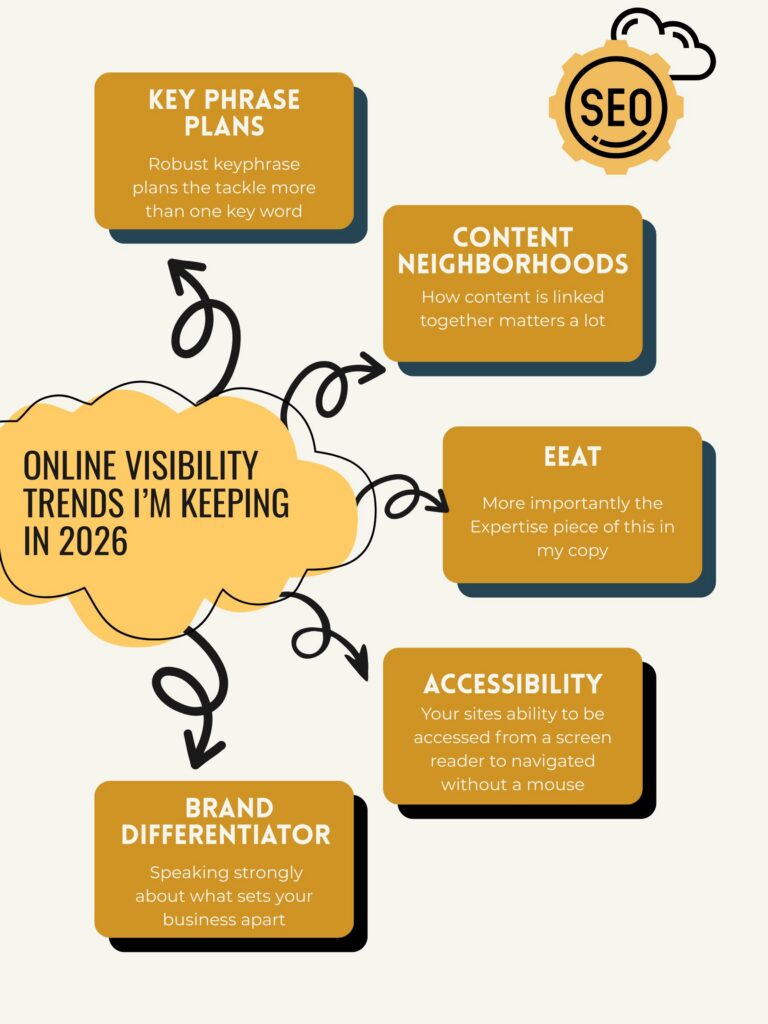
Clear, Robust Keyphrase Plans
Not one keyword. Not random ideas.
Structured plans. Primary phrases. Supporting phrases. Real search behavior woven together.
Without a keyphrase plan, everything becomes reactive. Key phrase planning is really my secret sauce when working with clients. I recently made a version of the exact template I use with my clients available. You can find more information the keyphrase template here if you’re stuck at this step.
If you’re ready to refresh your keyphrase plan, I have a free mini class on keyphrase planning to get your started.
Content Neighborhoods Are Especially Useful for AI
Internal linking is not decorative. It signals relationships. It distributes authority. It guides users intentionally.
Every page should connect for a reason. Read more about how internal linking is a secret weapon.
Demonstrating Real Expertise in Copy
Authority is demonstrated, not declared. Google calls this EEAT and AI search just calls this good practice. I fast way to boost your online visibility across all platforms is by demonstrating your authority and experience in your business.
Examples are clear processes, demonstrating your expertise by sharing lived experience, and going beyond an FAQ section to answer questions both niche and broad.
Users feel the difference but search engines are getting better at detecting it.
Accessibility Is a 2026 Push I’m Fully Standing Behind
Accessibility isn’t just a compliance trend or a technical add-on. It’s becoming part of what defines a high-quality website and results in more organic reach.
When your site has a clear structure, proper heading hierarchy, meaningful alt text, readable contrast, intuitive navigation, and fast load times, it becomes easier for real people to use. And that usability increasingly overlaps with how search engines evaluate quality.
That’s not separate from SEO. It strengthens it.
This is one of the areas I’m intentionally building into my recommendations right now, because it improves visibility and makes your site more resilient as search continues to evolve.
Technical Cleanliness is more than an SEO trend in 2026
Minimal bloat. Clean hierarchy. Fast pages. Clear structure. It doesn’t need a lot of explanation, but trust me when I say it still matters. Especially for newer websites.
Growing SEO the Right Way in 2026 is more than chasing trends
The businesses that grow this year won’t be the ones chasing every new platform or reacting to every headline. They’ll be the ones building infrastructure that holds steady no matter where search shows up next.
You don’t need more tactics layered on top of each other. You need clarity about what each page is doing, structure that supports long-term authority, and intentional decisions about what actually deserves your energy.
That’s how you grow the right way.
Check out a few of my favorite posts to get you started on refreshing your website for better SEO in 2026 and beyond. How to Use Google Search Console + Understanding Blogs Categories and Tags