I asked ChatGPT to do SEO for a photographer. I used the same kind of prompt a real photographer would type, used a real site I found burried deep in search, and in under a minute it handed back a 10-step plan and a priority checklist. What it didn’t do was ask a single question before delivering the results. If you’ve been using ChatGPT for your photography SEO (a lot of you are, and I’m not here to scold anyone, since I use AI in my business every day), this post walks through what it got right, what it missed, and why the misses matter more than the checklist. (Quick confession: ChatGPT has years of my own SEO work in its memory, so I had to ask it to pretend we’d never met. It took that surprisingly well.)
What to Expect
If you only read one section, make it this one.
- ChatGPT never asked a question. A strategist starts with your goals, your services, and understanding the time you have to commit. Whereas ChatGPT started with a tidy to-do list
- Your market searches differently than you (or AI) think. Keywords should come from what’s actually bringing your competitors traffic, not from what’s already on your website. AI worked inside out, whereas I tend to start outside (market) and go in.
- More pages isn’t automatically better. Build what your market needs and what you can realistically maintain. The BEST plan will sink if you can’t maintain the structure
- Technical SEO starts with your platform, and often with cleanup. Sometimes what you remove matters more than what you build. In addition what you build depends on your platform. WordPress to Wix is a world of difference.
- Your experience is the one thing AI can’t copy. It also happens to be what Google and AI search is looking for more and more. ChatGPT sort of blew past this. While EEAT (experience, expertise, authority, and trust) doesn’t fall into the technical checklist, it should be baked into everything you do for modern SEO.
What ChatGPT Got Right (and the Questions It Skipped)
The Prompt
Here’s exactly what I typed:
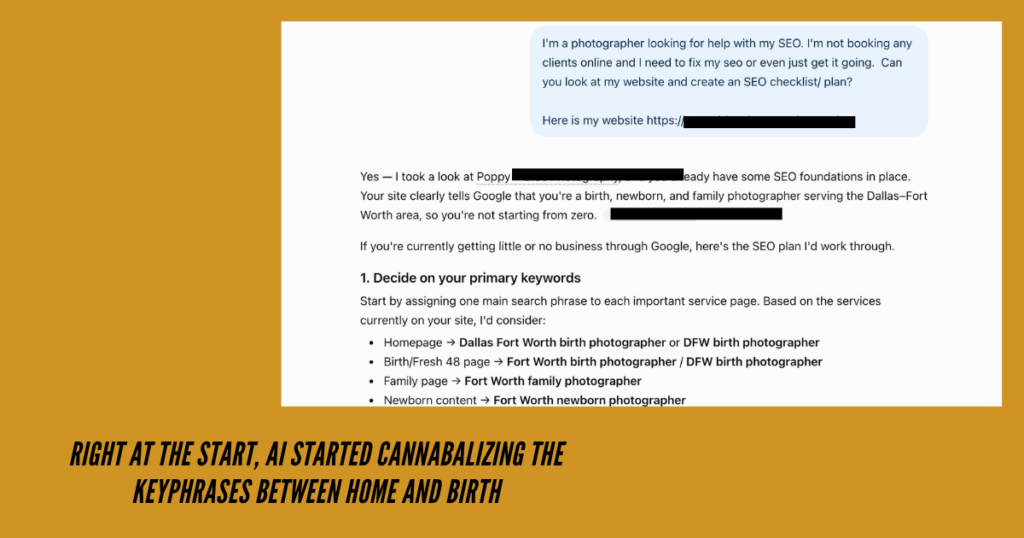
“I’m a photographer looking for help with my SEO. I’m not booking any clients online and I need to fix my SEO or even just get it going. Can you look at my website and create an SEO checklist/plan?”
I kept it simple on purpose. This is what photographers actually type at 11pm after a slow month (I’ve typed worse).
What It Got Right About My SEO Prompt
More than I expected, to be fair.
- It actually looked at the site. It referenced real headings, image file names, and an existing blog post. This has gotten better month over month with real scanning.
- It warned against keyword stuffing and those cookie-cutter “[city] photographer” pages I’m always talking people out of.
- It gave good image advice, including descriptive file names and alt text that describes what’s actually in the photo.
- It prioritized Google Business Profile and reviews, which is exactly right for a local business.
- It said to stop rewriting pages every few weeks and to give changes time to work. (Bless it.)
If a photographer followed this plan, they probably wouldn’t break anything (except for cannibalizing, but more on that later). They’d just spend months on work that may or may not matter for their business.
The Questions It Never Asked
ChatGPT’s approach: It went straight to a 10-step plan.
What that misses: Everything I’d want to know before building one.
- Which services do you want to book more of? (Not just the ones you offer.)
- How much time can you realistically give SEO each month?
- How long has your site been live, and what is it built on?
- Is the problem that nobody finds you, or that people find you and don’t inquire?
To be fair, I asked for the plan and didn’t prompt it to ask me clarifying questions. But that’s exactly the difference between working with a strategist and using AI for your SEO. AI doesn’t always know when it needs more data to give you the best plan, and it often can’t use the data without you buying expensive add-ons to give it access to the research.
When you’re new to SEO, you don’t know what you don’t know, so you take the plan at face value. Why wouldn’t you? It sounds smart, it’s organized, and it showed up in under a minute. Nothing in the process stops to ask, hang on, does this fit your business, your goals, or your actual time available to toss at it.
AI answers the question you asked quite literally. A strategist asks whether it’s the right question.
Keyword Research Starts With Your Competitors and Real-Time Data, Not Your Website
Every Market Searches Differently
ChatGPT’s approach: It looked at the services on the site and assigned “Fort Worth [service] photographer” to each page because Forth Worth was what it saw ON the page.
What that misses: How people in that market actually search to validate if your existing keyphrases make sense.
I’ve worked with hundreds of photographers across the US and in other countries, and I can tell you without a doubt that search habits vary wildly from one area to the next.
- In some markets, people never put the city in front of the service. In others, they do it without fail.
- Some areas search for “pregnancy photos” and would never type “maternity.”
- Some people call everything a “portrait,” whether it’s a newborn, a family, or their dog.
- “Fresh 48” might be what we call it, which isn’t necessarily what clients type into Google.
A keyword that looks obvious from inside your business might be one nobody in your area actually uses. I see this all the time and am always humbled when I see the data from a new-to-me area.
Look at What’s Bringing Your Competitors Traffic
ChatGPT’s approach: It picked keywords that made sense on paper.
What that misses: What’s already working for the photographers ranking in that area.
This is one of my favorite parts of building a strategy. I dig into what’s bringing traffic to competitors instead of guessing what should work, and that research tells you two things. First, how people really search. Second, what you’re up against. If page one is full of sites with 15 years of authority, you’re in for a long game. If page one is full of thin, outdated pages, there’s an opening, and you’ll want to move on it before someone else does. This is a topic for another day, but I LOVE competitors and digging through there data to look for opportunities.
Your keywords should come from how your clients search, not how photographers talk.
Watch for Two Pages Chasing One Keyword – Cannibalization is a big trap when using AI for SEO
ChatGPT’s approach: It flagged that some pages overlapped. Then it recommended “DFW birth photographer” for both the homepage and the birth page.
What that misses: Those two pages would now be competing with each other. I’m not sure why but this is one of the biggest… Oops moments I see with using AI to create a keyphrase plan. It happens A LOT.
This is called keyword cannibalization, and it’s exactly as fun as it sounds. Search has to guess which page matters most, and it doesn’t always guess the way you’d want. I see this in audits all the time from incoming clients, and it can hold a site back for months before anyone notices.
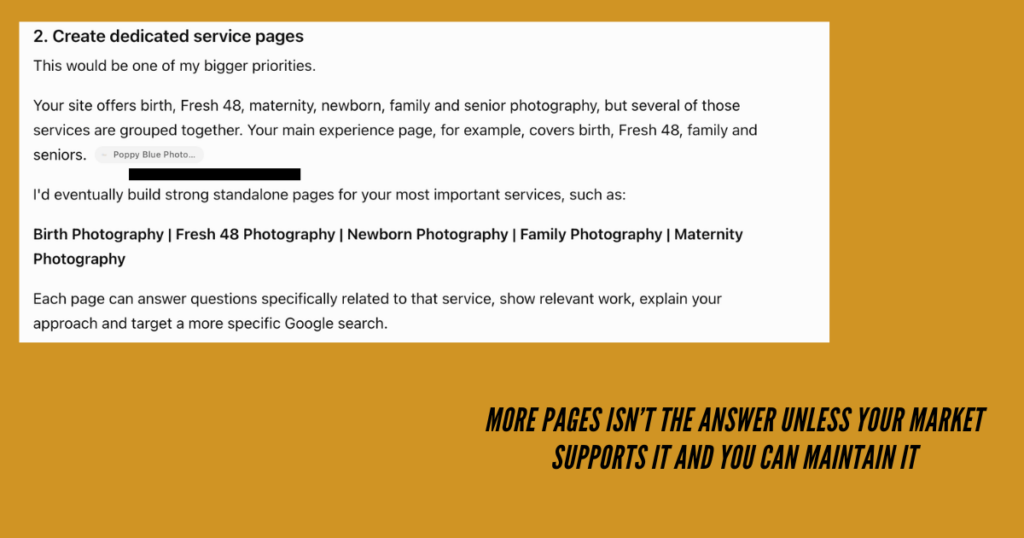
More Pages Won’t Help Your SEO If You Can’t Maintain Them
Service Pages Depend on Your Market (and Your Bandwidth)
ChatGPT’s approach: It said to build standalone pages for birth, Fresh 48, newborn, family, and maternity sessions.
What that misses: Whether this market needs them, and whether this photographer can support them.
Some areas don’t need a page for every service. More competitive markets often do. Either way, a service page can’t carry itself. It needs a portfolio, supporting blog posts, and reviews behind it, and five thin service pages will usually lose to one strong one.
Build what’s truly in your wheelhouse first. And if you’re trying to phase out a service, ranking for it doesn’t count as a win. It just gets you more inquiries you’ll end up turning down. We always wait to aim to be an expert and there is a real risk of dilluting our expertise with too much clutter.
Be Careful Splitting a Page That Already Works
ChatGPT’s approach: It suggested breaking the photographer’s main experience page into separate service pages.
What that misses: Whether that page is already the one Google trusts.
If it is, splitting it up could reset the progress it has earned. Sometimes the smartest SEO move is leaving the thing that works alone and building to support it. This isn’t a decision to make unless you put real data behind it.
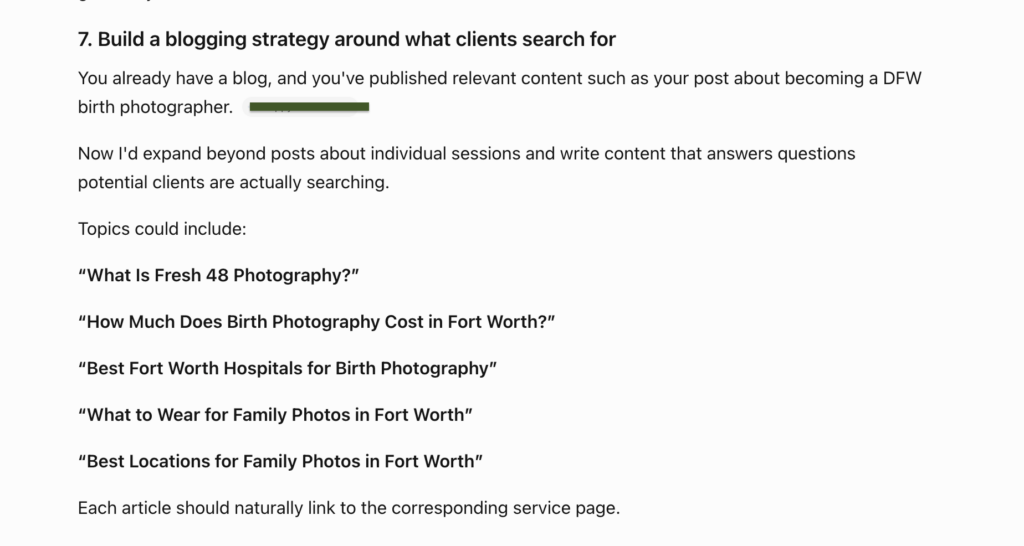
Generic Blog Topics Are Easy Pickings for AI Overviews
ChatGPT’s approach: It suggested posts like “What Is Fresh 48 Photography?” and “What to Wear for Family Photos.”
What that misses: Google often answers questions like these right at the top of the results in an AI Overview, so the searcher gets what they need without clicking. Also, a few hundred other photographers have already written that exact post.
The blog posts that hold up are the ones only you can write:
- A real session story from a specific hospital or birth center
- Locations you’ve actually shot, with your own photos
- Questions your own clients ask you, answered from experience
Technical SEO Is One Connected System
ChatGPT’s technical section was a tidy checklist of mobile usability, page speed, broken links, sitemaps, HTTPS, duplicate titles, and indexing. None of that is wrong. But on a photography site, those pieces don’t live in separate boxes. Your platform, your images, your old content, and your data all affect each other.
Your Platform Sets the Rules
ChatGPT’s approach: It never asked what the site is built on.
What that misses: Your platform decides what you can and can’t do, so your SEO plan should be built around its strengths and weaknesses.
Showit, WordPress, and Squarespace all handle things differently: what you can edit, how your blog connects to the rest of your site, and how much control you have over speed and code. A plan that ignores your platform hands you tasks you can’t actually complete (or can only complete with a developer and a budget you weren’t planning on).
Here’s an example. On a Showit site you can easily changed any text to H2, H2 etc without altering the design. On Squarespace, changing something to a H1 will directly impact the design of your site. It’s not as easy as change this text to a H1 on some builders. Or did you know a Meta Description is called an SEO description on Squarespace but not on Showit? The list goes on and on.
Pull quote: A good SEO plan takes into consideration your platform first.
Google Search Console Is Information, Not a Verdict
ChatGPT’s approach: It said to connect Google Search Console to see indexing, searches, and impressions.
What that misses: Most photographers don’t know how to read it, and what you see depends a lot on your traffic.
You should absolutely connect Search Console and learn the ins and outs. Just go in knowing this:
- Smaller sites often get “not enough data” in the Core Web Vitals report, because Google needs a certain amount of real visitor traffic to measure speed.
- Newer sites have fewer indexed pages and fewer impressions. That’s normal, and it doesn’t mean something is broken.
When the data does exist, though, it should shape the plan from day one instead of showing up in step nine. A page sitting just off page one is often a faster win than anything brand new.
Photography Sites Feel The Pain Of Image Problems More Than Most
ChatGPT’s approach: It recommended descriptive file names, alt text, and compressing files on a basic level.
What that misses: Just HOW important your alt text is, how small to compress your files and how you’re displaying them on your site. A scrolling carousel, a traditional portfolio grid, animations etc.
A typical small business site might have three or four photos on a page. A photography portfolio page might have 40 (or more), so every little inefficiency gets multiplied.
- Huge uploads that get shrunk down in the browser still slow the page.
- Some galleries and sliders are harder for Google to read than you’d think.
- A page with 40 images and two sentences gives Google very little to work with.
Sometimes Cleanup Matters More Than Building
ChatGPT’s approach: It focused on what to build, like new service pages, new blog posts, and new content.
What that misses: What should probably be cleaned up first before you think of building.
I’d say half my clients come to me for SEO help and fall into the clean-up bucket, not the build bucket. Photographers (and anyone who blogs regularly) collect pages Google doesn’t need to see:
- Tag and category pages – not all tags are created equal. Some might help your SEO, but more often than not, they are holding you back.
- Client ordering pages
- Thank-you and confirmation pages
- Session blog posts that are nearly identical to each other
Google still crawls and weighs all of it. When a site is full of thin, forgettable pages, the pages you actually care about have a harder time standing out. Cleaning these up can do more for you than publishing something new.
Broken Links and Redirects Add Up
ChatGPT’s approach: It listed “broken links” and “HTTPS” as checklist items.
What that misses: It didn’t actually check if either one exist or explain why they matter.
Link problems pile up fast on older photography sites, especially after a rebrand or a platform move.
- Broken links point to pages you deleted, or to vendors who closed up shop.
- Redirect chains happen when an old URL redirects to another URL, which redirects to another URL.
- Non-secure links are old “http://” links still sitting in blog posts, including links to your own site.
Each one seems small on its own. Together, they waste Google’s time on your site, leak the value of links you’ve earned, and annoy the people who click them.
Side note on conversion: ChatGPT also suggested looking at where visitors leave your site. That’s a great idea, but it only works if tracking is set up. If your Google Analytics isn’t setup, you can’t tell whether you have a visibility problem or a conversion problem, which was the whole question to begin with.
Experience Is the One Thing AI Can’t Write for You
What E-E-A-T Means for Photographers
ChatGPT’s approach: It didn’t mention it.
What that misses: Showing real-world experience is one of the clearest ways to stand out, to Google and to the people you want to book.
Google’s quality guidelines use a framework called E-E-A-T, which stands for Experience, Expertise, Authoritativeness, and Trustworthiness. That first E is where photographers have a real advantage. You’ve actually been in the delivery room. You know which hospital has the terrible lighting (and exactly where to stand to work around it).
You show that experience through real session stories, your process, the behind-the-scenes details, and reviews that describe what working with you was actually like.
Your Experience Shows Up Off Your Website Too
ChatGPT’s approach: It covered your Google Business Profile and reviews.
What that misses: Everything else Google and AI search tools use to piece together who you are.
For a birth photographer, that might include:
- Referral relationships with doulas, midwives, and birth centers
- Vendor features and local publications
- Consistent business info everywhere you appear, reinforced on your website with schema (behind-the-scenes code that tells Google who you are, what you do, and where). Schema is worth doing right, which for most people means getting a little help.
Don’t Optimize Your Personality Out
ChatGPT’s approach: Its sample heading was “Relaxed Family Photography.”
What that misses: It’s technically fine, and it sounds like every other photographer’s website.
SEO gets people to your site. Your words are what make them think, Oh. THIS is my person. We don’t just want you to rank. We want the right people to land on your site and feel like they’ve found you.
Pull quote: An SEO-perfect heading often sounds like it was written by a toaster.
So, Should You Use ChatGPT for Photography SEO?
Yes, as a starting point. It’s great for explaining terms, brainstorming, and getting a first draft on the page. I prefer Claude over ChatGPT but a lot of that is personal preference.
If you use it, add this to your prompt:
“Before you give me a plan, ask me questions about my goals, the services I want to book more of, how much time I have each month, what platform my site is on, and how long it’s been live.”
And if you only have four hours this month, start here:
- Look at who’s ranking for the service you most want to book, and notice what their pages have that yours doesn’t.
- Rewrite the title tag and H1 on your page for that service.
- Ask three recent clients for Google reviews, and gently mention the kind of session they booked.
AI can get you close. Figuring out which parts of close actually matter for your business is where a strategist in your corner makes the difference. From one-hour consulting calls to a full VIP experience, here are my services for photographers.